
Laminar Flow Hood: Laminar Cleanliness, Safeguarding Critical Processes

A laminar flow hood is an air purification device designed to provide a highly clean environment for localized areas. It primarily consists of an enclosure, fan, high efficiency particulate air (HEPA) filter, diffuser plate, lighting systems, and other components. The unit creates a stable unidirectional airflow (vertical/horizontal) by forcing air through HEPA or ULPA filters, effectively isolating the work zone from external contaminants while maintaining superior cleanliness standards.

This product features a compact structure and easy operation, and can be optionally equipped with lighting systems, differential pressure gauges, pre-filters, and other functional components. It is suitable for critical processes with stringent requirements, such as aseptic operations, sample protection, and precision assembly.

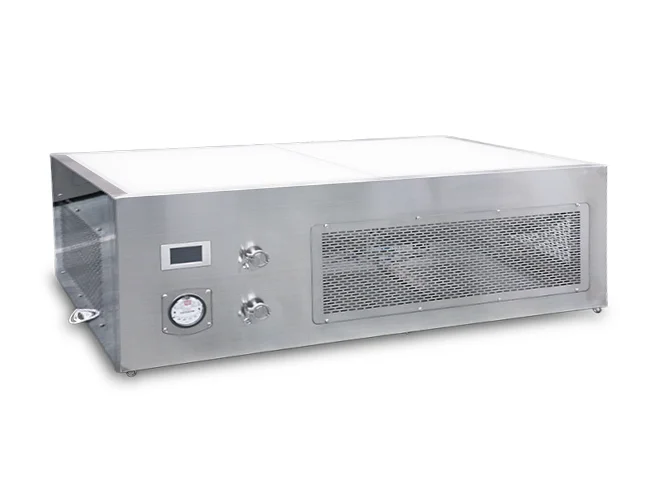
A stainless steel laminar flow hood
Features
  • Providing a localized Class 100 clean environment. Utilizing HEPA or ULPA filters with filtration efficiency up to 99.99% or higher, it effectively capture particles ≥ 0.3 μm to meet ISO 5 or Class 100) cleanroom requirements.
  • Unidirectional (laminar) airflow design. Clean air flows at a uniform speed in a single direction (horizontal or vertical), forming a stable air layer that prevents outside air intrusion and rapidly removes contaminants from the workspace.
  • Built-in fan system. An integrated fan drives air through HEPA filters, making the system an independent air circulation and purification unit that requires no external ductwork, enabling easy installation.
  • Low-noise, low-vibration design. Equipped with a high-performance, quiet fan and excellent vibration-damping structure, suitable for noise-sensitive environments such as laboratories and clean workshops.
  • Enclosed or semi-enclosed workspace. It helps prevent external contamination from entering the working area while allowing operators easy access to materials, enhancing both safety and convenience.
  • Multiple configurations available (vertical/horizontal laminar flow). Air delivery options can be selected based on process requirements – for example, vertical laminar flow hoods are ideal for handling sensitive materials, while horizontal laminar flow hoods are better suited for assembly tasks in controlled environments.
  • Wide range of applications. Widely used in electronics, biopharmaceuticals, medical devices, food processing, and laboratories where high local air cleanliness is required.
Structure
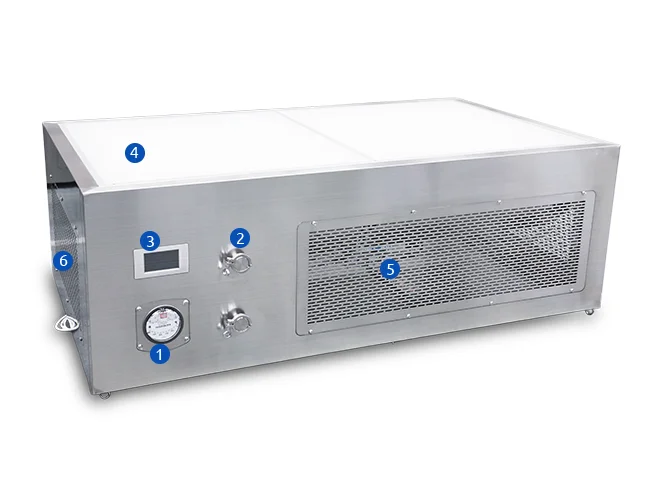
  1. Differential pressure gauge
  2. DOP/POA test port
  3. LCD display
  4. Airflow equalizing membrane/diffuser plate
  5. Air inlet grille
A stainless steel laminar flow hood with many accessories
Working Principle
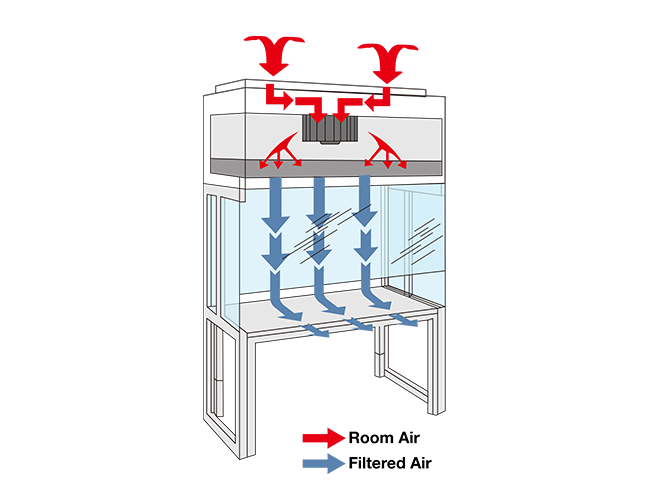
  • Air Intake
    The laminar flow hood draws in ambient air through the top or rear air inlet grille. In some models, the air first passes through a coarse air filter to remove large dust particles.
  • Filtration & Purification
    The incoming air passes through a high-efficiency particulate air (HEPA) filter (efficiency ≥99.99%@0.3 μm) or an ultra-low penetration air (ULPA) filter (efficiency ≥99.9995%@0.12 μm), filtering out the vast majority of particulates and microorganisms.
  • Formation of Laminar (Unidirectional) Flow
    Filtered air is delivered at a constant velocity and in a constant direction from beneath the filter (vertical laminar flow) or from the front (horizontal laminar flow), forming a stable laminar airflow that pushes contaminants outward from the work zone.
  • Contaminant Removal
    Particles or contaminants generated during operations are quickly swept away by the airflow instead of retaining in the work zone, thereby maintaining area cleanliness.
Cross-sectional diagram of the internal working principle of the laminar flow hood
Specification
  • Material: The enclosure and all parts are constructed from SUS304.
  • Air Inlet: Side or top entry
  • Pressure: Negative or positive pressure
  • Cleanliness Class: Class A
  • Average Air Velocity: 0.45±20% m/s
  • Noise: ≤ 65 dB
  • Illuminance: ≥ 300 LUX
  • Testing: POA scan leak test port
  • Functions: Air velocity feedback, variable frequency speed control, multi-parameter alarm system, and touchscreen operation.
Table 1: Laminar Flow Hood Specifications
Model Rated Airflow External Dimensions (L × W × H) Work Zone Dimensions HEPA Specification Power Supply
m³/h mm mm mm
JLFZJ-600 600 730 × 730 × 790 1220 × 610 610 × 610 × 90 AC-220 V / 50 Hz
1 pcs
JLFZJ-1200 1200 1350 × 730 × 790 1220 × 610 610 × 610 × 90
2 pcs
JLFZJ-1800 1800 1350 × 1030 × 790 1220 × 915 915 × 610 × 90
2 pcs
JLFZJ-2400 2400 1350 × 1350 × 790 1220 × 1220 1220 × 610 × 90
2 pcs
JLFZJ-4800 4800 2830 × 1030 × 790 2440 × 915 915 × 610 × 90
4 pcs