



Pass Box – Prevent Cross-Contamination with Every Pass

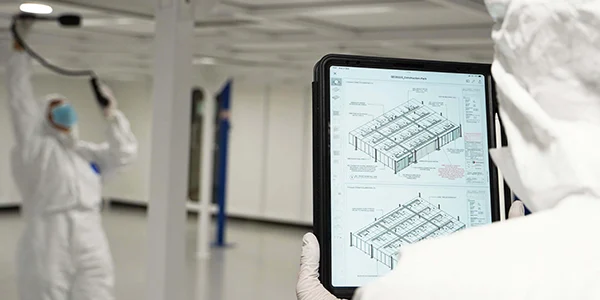
A pass box is an auxiliary device installed in cleanrooms, primarily used for transferring small items between clean zones, or between clean and non-clean zones. It effectively reduces the frequency of cleanroom door openings, thereby minimizing the risk of external air contaminating the clean zone.

Constructed with high-quality 304 stainless steel plates, the unit features smooth inner surfaces for easy cleaning and disinfection. The dual-door interlock design prevents both doors from opening simultaneously, effectively blocking cross-contamination. Besides, it is equipped with either electronic or mechanical interlocking mechanisms. Some models can also be configured with UV sterilization lamps to further enhance cleanliness and safety during transfer.

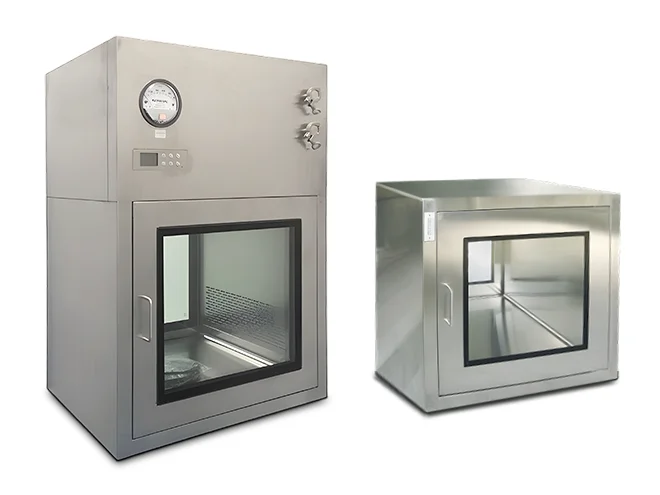
Stainless steel static pass box and dynamic pass box
Working Principle
Mechanical Interlock

Mechanical interlock uses physical linkage devices (such as springs, hooks, and levers) to achieve physical locking. When one door is open, the other door remains locked, preventing simultaneous opening.

It is widely used in standard-grade cleanrooms, laboratories, and other environments with low requirements for intelligent control.

  • Simple structure, stable and reliable
  • No power supply required, easy maintenance
  • Lower cost
  • Slightly slower response time, somewhat heavier operation feel
  • Suitable for applications with basic functional requirements where interlocking must be maintained during power outages
Electronic Interlock

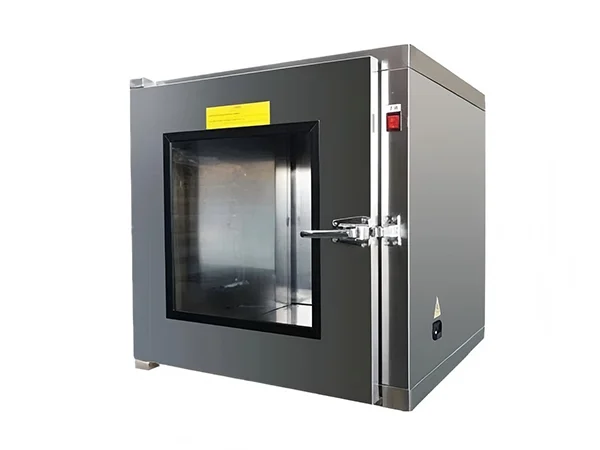
Electronic interlock achieves interlocking logic via an electronic control system. It employs sensors (such as magnetic door sensors or infrared sensors) and control circuits to monitor the opening status of both doors, automatically performing locking and unlocking operations.

It is commonly used in pharmaceuticals, biotechnology, electronics, and other settings with high cleanliness and management requirements.

  • Intelligent control, can be integrated with access control and air shower systems
  • Easy operation and rapid response
  • Supports functions such as alarm notifications and delayed locking
  • Higher cost, heavily dependence on power supply
  • Emergency procedures are required in the event of circuit failure or power outages
Static Pass Box
Overview

A static pass box is an auxiliary device used for transferring items between cleanrooms and non-cleanrooms, or between areas with different cleanliness classifications within a cleanroom. By reducing the frequency of door openings, it effectively lowers the risk of air contamination in clean zones and controls cross-contamination. This product features a compact structure and easy installation, making it an indispensable component of cleanroom control systems.

A stainless steel static pass box

Static pass box

Advantages
  • Cabinet material: Premium 304 stainless steel – robust, durable, and highly corrosion-resistant
  • Surface treatment: Epoxy resin coating on exterior surfaces enhances wear and corrosion resistance.
  • Inner cabinet structure: 304 stainless steel interior with rounded corners on all sides and a smooth, flat surface for easy cleaning and disinfection.
  • Sealing performance: Food-grade silicone sealing strips effectively ensure excellent airtightness.
  • Safety design: Mechanical or electronic interlock system with reinforced structure ensures operational safety.
  • Optional accessories: Mechanical interlock, electronic interlock, sterilization lamp, fluorescent lamp.
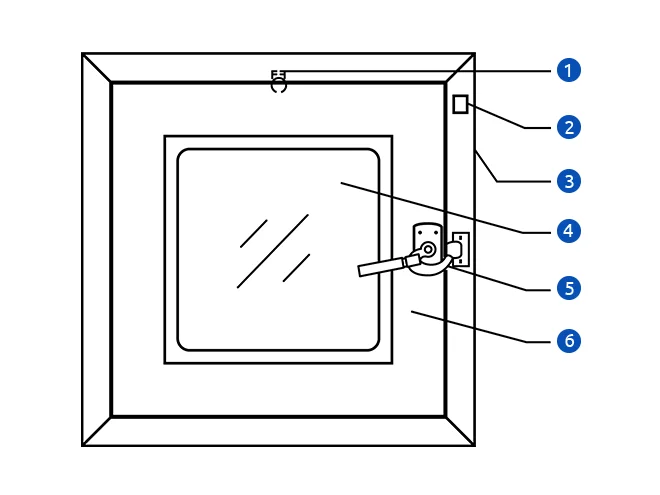
Structure
  1. Sterilization lamp
  2. Sterilization lamp switch
  3. Cabinet
  4. Glass window
  5. Handle
  6. Door
A static pass box structural drawing
Specifications
Table 1: Static Pass Box Specifications
Model JPBS-500 JPBS-600
External dimensions (W × D × H, mm) 655 × 570 × 590 755 × 670 × 690
Internal dimensions (W × D × H, mm) 500 × 500 × 500 600 × 600 × 600
Gross weight (kg) 110 140
Net weight (kg) 80 110
Packing dimensions (W × D × H, mm) 810 × 810 × 740 910 × 910 × 840

Note: Customization available upon request.

Dynamic Pass Box
Overview

The dynamic pass box, based on the standard cleanroom pass box, integrates a built in (HEPA/ULPA filter system and a fan unit. It achieves internal chamber self-cleaning during item transfer, effectively removing dust particles and elevating the cleanroom classification level. This makes it ideal for applications with higher cleanliness requirements.

It is commonly used in pharmaceutical, bioengineering, laboratory, and other high-grade clean environments, ensuring that no contaminants are introduced during the transfer process.

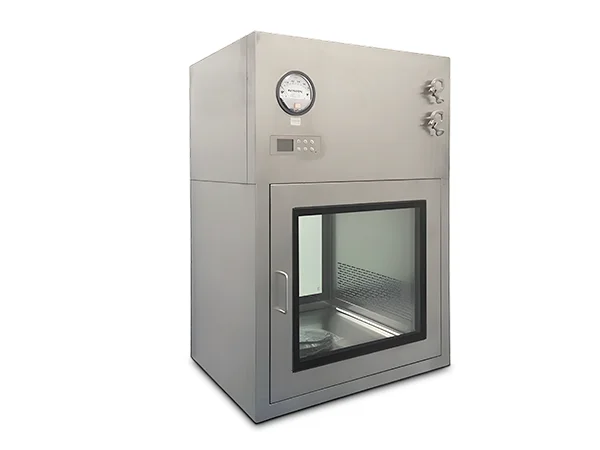
A stainless steel dynamic pass box with a fan

Dynamic pass box

Advantages
  • Cabinet structure: Constructed from high-quality 304 stainless steel with a smooth, flat surface for easy cleaning.
  • Surface treatment: Exterior finished with an epoxy resin coating for enhanced corrosion resistance.
  • Fan system: Equipped with a permanently lubricated direct-drive centrifugal fan for stable operation and low noise, with noise levels under 60 dB during operation.
  • Filtration system: Fitted with a mini-pleat HEPA filter with >99.99% efficiency @ 0.3 μm; optional DOP test port available for filter integrity verification.
  • Air outlet design: Optional stainless steel nozzles deliver high-velocity airflow for more efficient dust particle removal (standard configuration includes a airflow equalizing plate).
  • Sealing performance: Utilizes sanitary-grade silicone sealing strips to ensure excellent overall airtightness.
  • Interlocking & safety: The electronic interlock system effectively prevents cross-contamination between internal and external airflow, while the reinforced structural design enhances overall safety.
  • Monitoring function: Equipped with a differential pressure gauge for real-time monitoring of filter performance, facilitating maintenance and replacement.
  • Installation & compatibility: The well-designed structure allows for easy installation and is compatible with various cleanroom environments.
  • Optional accessories: ULPA filter, tempered glass window and door, conveyor device (rollers), activated carbon filter, UV sterilization lamp, ozone generator, differential pressure gauge, DOP test port, UV lamp timer, electronic interlock, mechanical interlock, fluorescent lamp, etc.
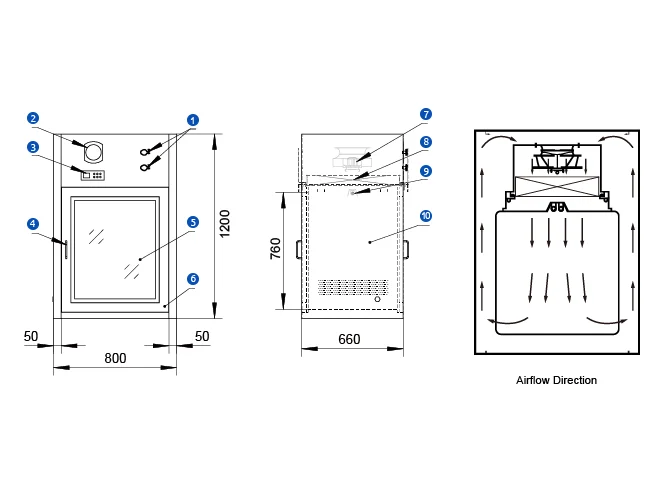
Structure
  1. DOP injection/output port
  2. Differential pressure gauge
  3. Control panel
  4. Stainless steel handle
  5. Window glass
  6. Door
  7. Fan
  8. HEPA filter
  9. Sterilization Lamp
  10. Cabinet
The front and side view of dynamic pass box structural drawing
Specifications
Table 2: Dynamic Pass Box Specifications
Model JPBD-600
External dimensions (W × D × H, mm) 755 × 670 × 1000
Internal dimensions (W × D × H, mm) 600 × 600 × 600
Air exchange rate 1500 times/h
Airflow velocity (m/s) ≥ 0.5
HEPA filter (L × W × H, mm) 484 × 484 × 70
Basic air shower time (s) Factory setting: 30 seconds (customizable)
Filtration efficiency HEPA filter: >99.99% filtration efficiency or 0.3-micron dust particles
Coarse air filter: Suppression rate 90%, filtration efficiency 20%
Filtration components HEPA filter: HEPA filter; coarse air filter: replaceable, non-woven fabric
Cabinet material High-quality 304 stainless steel
Power specifications 220 V AC 50 Hz
Power ( kW) 0.3
Gross weight (kg) 270
Net weight (kg) 150
Packing dimensions (L × W × H, mm) 840 × 750 × 1100